
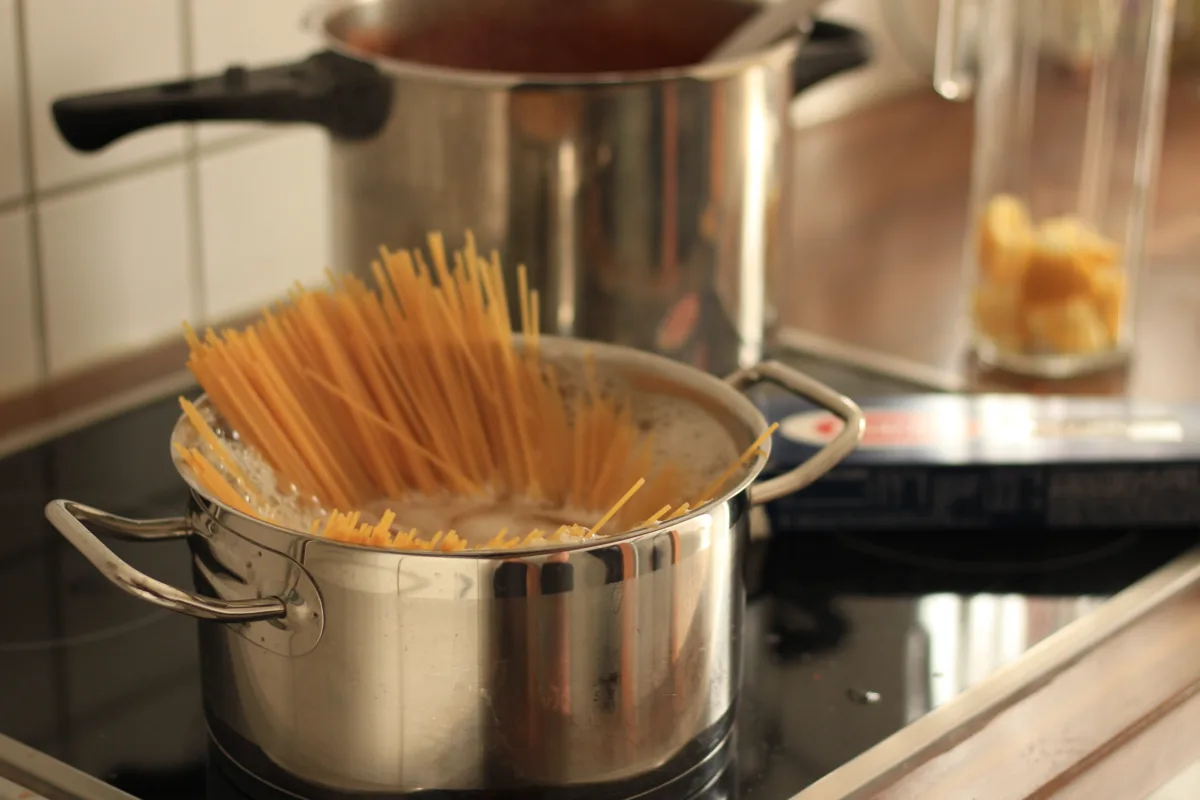
How much salt should you add to pasta water? Start with 5 grams per liter, or about about ¾ to 1 teaspoon of table salt. For a typical 4-liter pot, that’s 20 grams.
But why do chefs give such different advice?
One recommends a handful, another suggests two tablespoons, and someone else says the water should taste like the sea.
Here’s something surprising: A tablespoon of Diamond Crystal kosher salt weighs about 8 grams, while Morton kosher salt weighs 16 grams. Same spoon, twice the salt.
So who’s right?
It depends on the salt you’re using, how much water you have, and what you’re cooking.
How Much Salt Should You Add to Pasta Water?
The amount of salt depends on how much water you’re using and how salty you like your pasta.
For everyday cooking, 5 grams per liter is a good starting point. If you prefer more heavily seasoned pasta, you can try 10 grams per liter.
Here’s what that looks like for different pot sizes.
| Water in your pot | Moderate (5 g/L) | Stronger (10 g/L) |
|---|---|---|
| 1 liter (about 1 quart) | 5 g | 10 g |
| 2 liters (about 2 quarts) | 10 g | 20 g |
| 3 liters (about 3 quarts) | 15 g | 30 g |
| 4 liters (about 1 gallon) | 20 g | 40 g |
| 6 liters (about 6 quarts) | 30 g | 60 g |
The 5 g/L amount is our suggested starting point, slightly above Bon Appétit’s published recommendation when converted to grams per liter. The stronger 10 g/L option comes from a Serious Eats taste test, where Daniel Gritzer preferred a 1% salt concentration.
Neither is a rule everyone must follow.
If you’re making carbonara, cacio e pepe, or another pasta dish with salty cheese or cured meat, consider starting with less salt. You can always adjust the seasoning once the pasta and sauce come together.
One important detail: These amounts are measured by weight. If you’re using tablespoons instead, the type of salt makes a surprisingly big difference.
Your Tablespoon of Salt Might Weigh Twice as Much as You Think
Imagine two people making spaghetti. Both follow a recipe that calls for two tablespoons of salt.
One uses Diamond Crystal kosher salt. The other uses Morton kosher salt.
They’ve followed the exact same instructions, but one has added twice as much salt by weight.
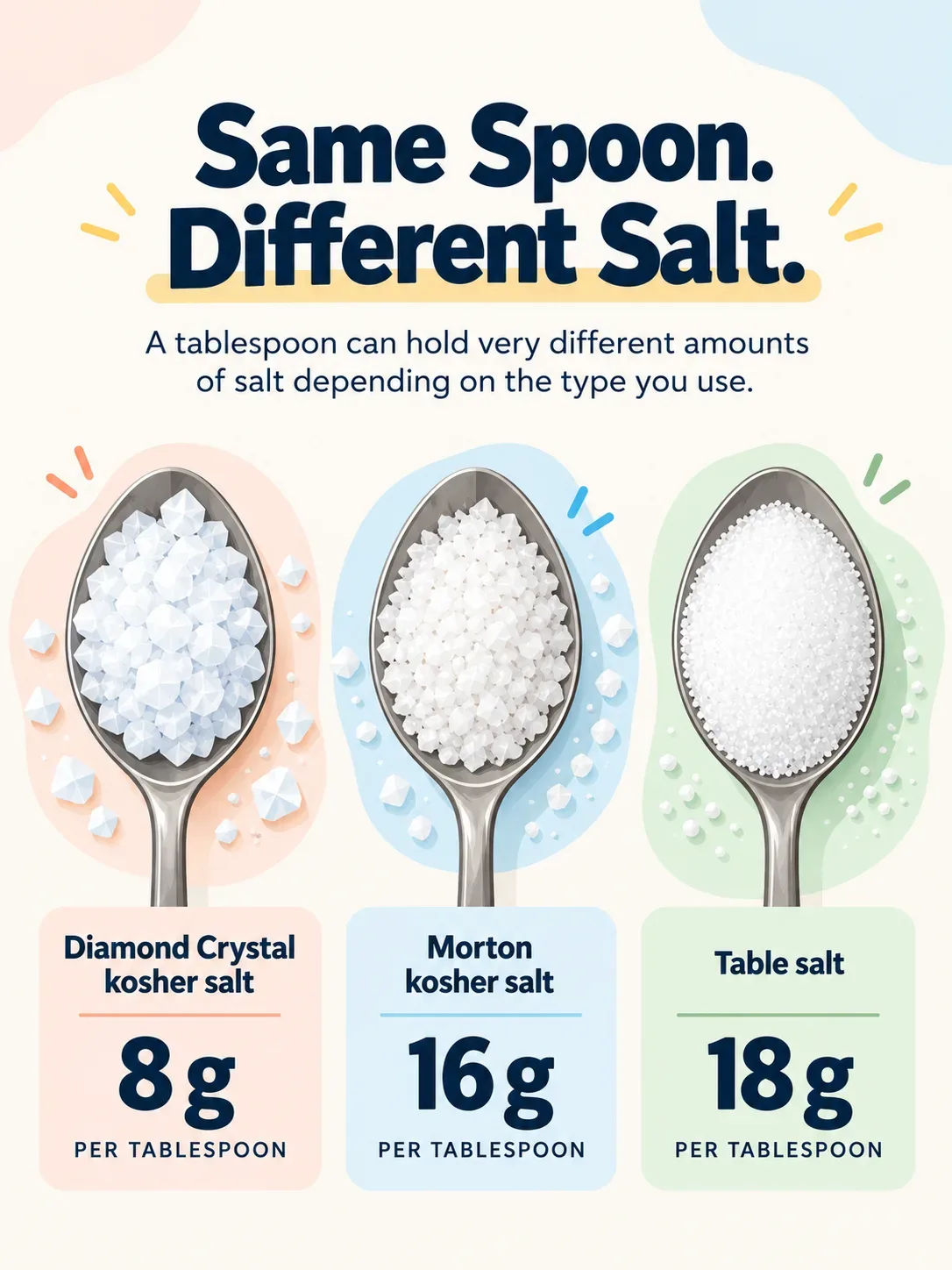
A tablespoon measures volume, not weight. Because different salts have different crystal shapes and packing densities, the same spoon can hold very different amounts of salt.
And once that salt dissolves in water, the crystal shape no longer matters. What matters is how much salt you’ve actually added.
That’s why measuring in grams is more reliable, especially when a recipe doesn’t specify which salt to use.
Why Do Chefs Give Such Different Advice About Salting Pasta Water?
Some chefs carefully measure their salt. Others throw in a generous handful.
Samin Nosrat, author of Salt Fat Acid Heat, favors generous seasoning and uses Diamond Crystal kosher salt. As we’ve seen, that matters when you’re measuring by volume.
But salt type isn’t the only reason recommendations differ.
In his Serious Eats taste test, Daniel Gritzer preferred pasta water containing 1% salt, or 10 grams per liter. That’s twice our suggested starting point.
Neither approach is necessarily wrong. Different cooks prefer different levels of seasoning.
Rather than copying a chef’s handful, consider the type of salt, the amount of water, and the dish you’re making.
Should Pasta Water Really Taste Like the Sea?
You’ve probably heard the advice: Your pasta water should taste like the sea. But should it?
Average seawater contains about 35 grams of salt per liter, seven times our suggested starting point.
| Salt concentration | Salt per liter |
|---|---|
| Our suggested starting point | 5 g |
| Stronger seasoning | 10 g |
| Average seawater | 35 g |
For a 4-liter pot, matching seawater would mean adding approximately 140 grams of salt.
“Salty as the sea” is better understood as a reminder to season your pasta water, not a measurement to follow literally.
How Much Salt Actually Ends Up in Your Pasta?

If you add 20 grams of salt to a pot of water, are you eating 20 grams of salt?
No. Most of that salt stays in the cooking water and goes down the drain.
But some of it does make its way into the pasta.
A 2019 study published in Food Chemistry examined how cooking-water salt levels affected the sodium content of pasta.
Under one set of tested conditions, a 140-gram serving of cooked pasta contained approximately 247 mg of sodium. When the researchers doubled the salt concentration in the cooking water, the sodium content rose to approximately 490 mg per serving.
That’s nearly twice as much sodium, even though the pasta was drained in both cases.
The lesson isn’t that you need to stop salting pasta water.
It’s that the amount of salt in the water can affect how much sodium ends up in your pasta.
And remember, that’s before adding sauce, cheese, or other ingredients.
Should You Use Less Salt When Your Pasta Sauce Is Already Salty?
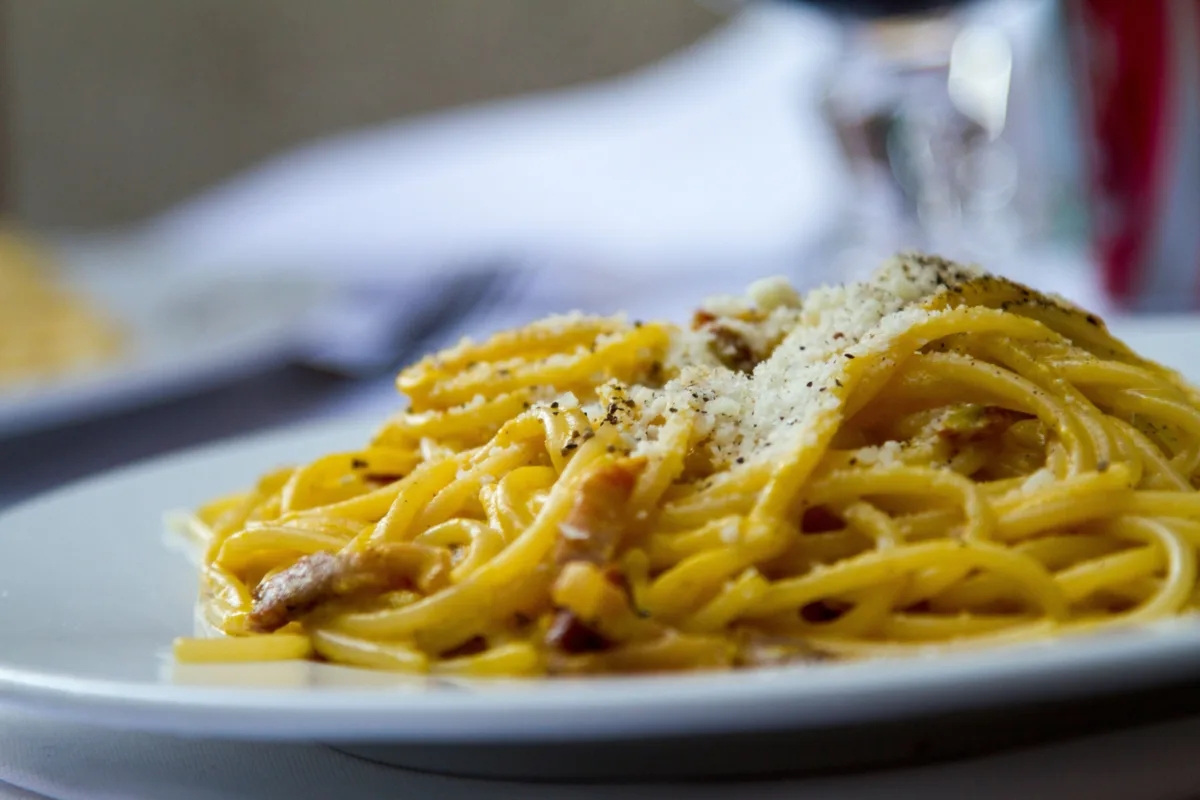
You’re seasoning the whole dish, not just the pasta.
Carbonara already contains salty ingredients like Pecorino Romano and cured pork. The same goes for sauces made with anchovies, olives, or Parmesan.
And if you add reserved pasta water to your sauce, you’re adding some of its dissolved salt too.
Our suggestion: Start with less salt in the cooking water when your sauce contains several salty ingredients. Taste the finished dish before adding more.
The goal isn’t perfectly salted pasta water. It’s a well-seasoned plate of pasta.
What If You’ve Added Too Much Salt to Pasta Water?
Still cooking? Replace some of the salty water with fresh, unsalted water to dilute it.
Already cooked? Taste the pasta before adding sauce. If it’s slightly too salty, try pairing it with an unsalted sauce.
Should you rinse it? A 2019 Food Chemistry study found that rinsing reduced pasta’s sodium content by about 34% under the tested conditions.
The downside? Rinsing also washes away starch that helps sauce cling.
If the pasta is extremely salty, starting over may be your best option.
Next Time You Make Pasta, Try This
Instead of following a chef’s handful of salt, measure what you’re adding.
Start with 5 grams per liter of water. When the pasta is cooked, taste a piece before adding the sauce.
Is it seasoned enough? Does the sauce make it too salty? Would you prefer a little more salt next time?
That’s how you find the amount that works for you.
The goal isn’t to salt pasta water like a famous chef. It’s to make pasta that tastes good to you.
Explore more food guides: From cooking tips to everyday kitchen questions, find more practical advice in our Food Guides collection.
